
Sources for Vallejo Previous Residents
A Vallejo house history for previous residents has two layers. Deeds and maps follow ownership and land identity. Vallejo directories, census schedules, newspapers, permits, and probate can place people at the address or explain a transfer. No one source supplies every past household. The strongest trail states what each source covers and whether access is online, in a public office, at a library, or by request.
| Source | Years or era | Where held | What it shows |
|---|---|---|---|
| Solano official records | 1955-present online; 1954-earlier office research | Recorder web index and counter books | Ownership instruments and legal descriptions |
| Vallejo city directories | 1870-1991 reported span | Genealogy collection, library, digitized catalogs | Named residents, occupations, addresses, street sections |
| Federal population schedules | 1850-1950 public under the 72-year rule | NARA, FamilySearch, library databases | Household members, ages, birthplace, occupation, tenure fields |
| Building permits | Modern eTRAKiT coverage; start not stated | Vallejo Building Division and older files | Construction, work dates, applicants, contractors |
| Sanborn maps | 1886, 1889, 1901, 1919, corrected 1919-1950 | Library of Congress and library databases | Footprint, use, materials, street number at map date |
| Newspapers and probate | Local runs vary; obituary listings 1999-present reported | JFK Library, Recorder, Solano Superior Court | Death, survivors, notices, heirs, property references |
The Vallejo dates are research boundaries, not a promise of a continuous run. Keep the source name and exact year with every Vallejo past-resident clue.
Begin with Today's Vallejo Parcel
Start at the current Vallejo situs address in Solano Property Search. If the Vallejo address fails, open the county GIS viewer, select the parcel, and copy the APN. Write down situs, assessed owner, mailing destination, APN, subdivision, and legal-description clues in separate fields. A mailing destination can be an agent, trust, PO box, or prior address. It is not proof of current residence.
The APN is the durable bridge to a Vallejo deed and map, although a split or merge can create a new assessment key. Save every Vallejo APN seen in the chain. The legal description, lot, block, subdivision map, and mapped footprint can remain useful when a Vallejo street number or suffix changes.
Walk the Solano Grantor-Grantee Chain
The Solano Official Records Search indexes names, dates, document numbers, APNs, and document clues, with online coverage from 1955 forward. It does not display instrument images. Search the current Vallejo owner as grantee, find the acquisition document, and order or inspect the Vallejo deed. Take the seller or grantor from that instrument and search the name as an earlier grantee. Repeat only after matching the legal description and APN.
- Confirm the current Vallejo APN and legal description from the assessment or parcel map.
- Search the current Vallejo owner in Official Records in both name orders and with a date range.
- Request the acquisition instrument and read grantor, grantee, recording date, number, APN, and Vallejo legal description.
- Search the earlier grantor as a grantee and test spelling, trust, marriage, and probate variants.
- Move to the Recorder's Vallejo public research area for 1954 and earlier books when the web index stops.
Deeds of trust can support a timing clue but are not the same as a conveyance. Probate, quitclaims, and estate transfers can branch the Vallejo chain. The Recorder's search help explains the simple and advanced search modes.
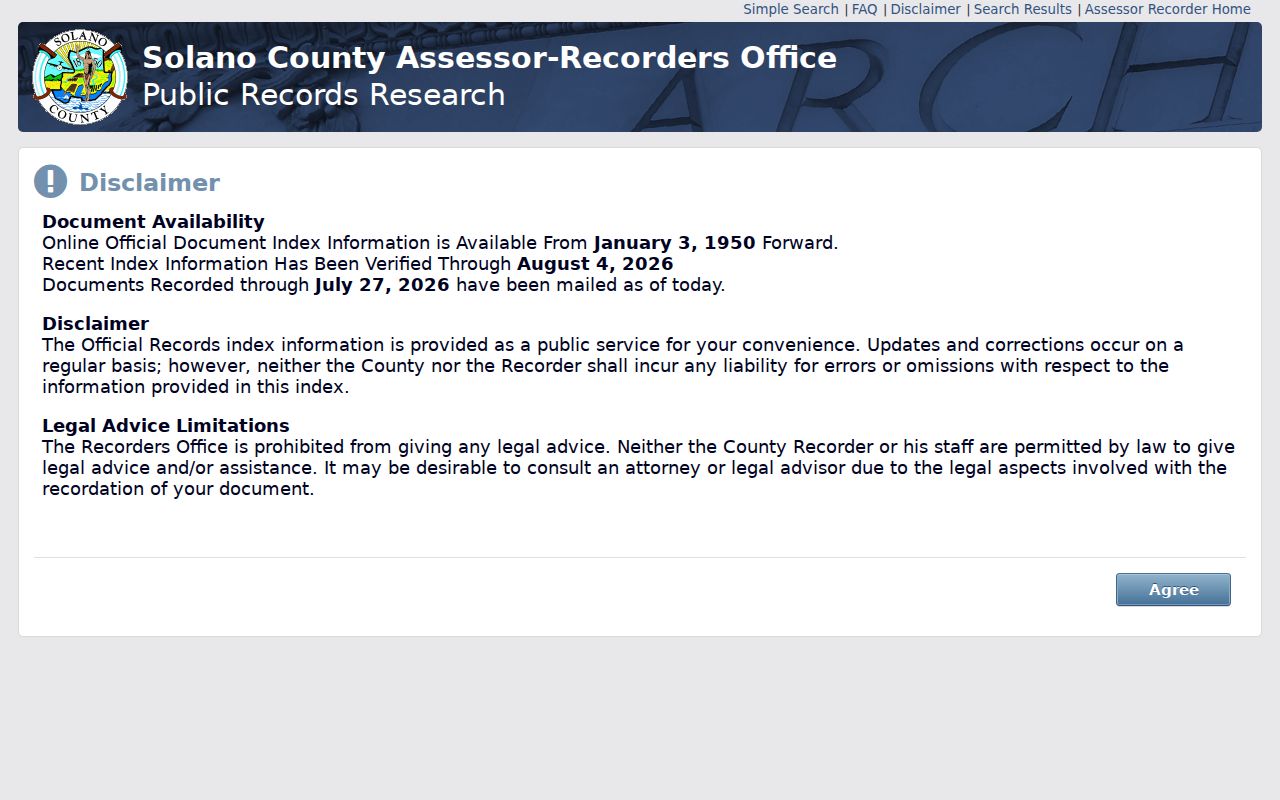
The Vallejo index points to a Vallejo instrument. It is not a substitute for reading the deed image or certified copy.
Where Vallejo's Web Index Stops
Solano's online recorder index is documented for 1955-present, while 1954 and earlier Vallejo research moves to the Vallejo office research area. The exact oldest online year is not published. At the counter, ask about older grantor-grantee books, computer terminals, deed copies, maps, and microfilm. The reported copy charge is $9 for the first page, $1 for each additional page, and $5 for certification. Confirm the current fee schedule before ordering.
The Vallejo county office route is not the same as a CPRA request. The Recorder has a statutory instrument and index channel. A focused California Public Records Act request is better for Vallejo administrative material that is not already in the recorder or court route. Inspection is ordinarily free, and an agency generally determines whether identifiable disclosable records exist within 10 days, with a possible 14-day unusual-circumstances extension.
When a Vallejo record is not online, the fallback chain is counter, phone, copy order, library, museum, archive, then a focused request to the correct custodian.
The Solano Official Records Search entry is the source shown below.
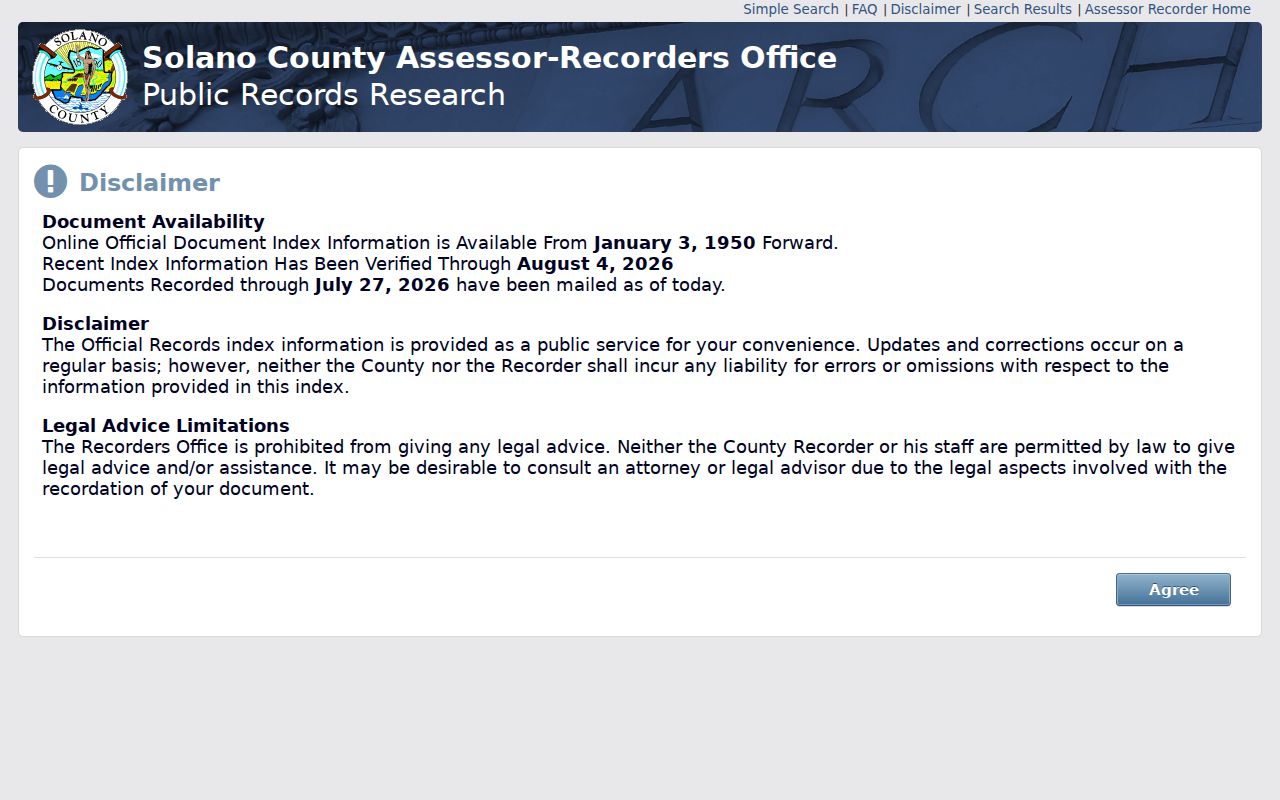
The Vallejo disclaimer makes the key boundary clear: the online result is an index, and document images must be obtained through the Recorder.
Match Deeds to Vallejo Directory Years
Vallejo ownership and occupancy should be plotted on separate lines. Vallejo city directories are reported from 1870 through 1991, with identified digital or cataloged years such as 1874, 1901-02, 1904, 1911, 1912-13, 1915, 1917, 1918, 1920, 1925-26, 1930-31, 1935, 1942, 1947, 1950, 1953-55, and 1957-60. Later Vallejo volumes may include a criss-cross section by street and number. The collection has gaps to verify.
Set a Vallejo directory year beside each deed date. A deed can show when ownership changed; a directory can show who was listed at the address in a publication year. A name may be a resident, business, boarder, spouse, or widow entry. Photograph the abbreviation key and save the page. The Vallejo city directory shelf explains how to read the volume without rebuilding it here.
A Vallejo mismatch is useful. It may show that the Vallejo owner did not occupy the parcel, a directory year lagged a move, or a legal address changed. Test the reason with the next source.
Pair Vallejo Directories with Census
Federal population schedules are public through 1950 under the 72-year rule. Pair the 1910, 1920, 1930, 1940, and 1950 census years with the closest Vallejo directory volume, then compare Vallejo household members, ages, birthplace, occupation, and tenure fields. The directory can fill an in-between year; the census can test whether a household member was present in an enumeration year.
- Choose a directory entry with a known street and year.
- Search the nearest public census schedule by name and enumeration district.
- Compare spouse, children, ages, birthplace, occupation, and address clues.
- Return to the next directory volume and record movement or name changes.
Neither Vallejo source is complete. A directory can omit a household, and a census can use a different house number or enumeration route. Use the APN, legal description, cross streets, and mapped footprint to keep the Vallejo address fixed for a Vallejo house history.
Permits and Sanborn Maps Date Vallejo Buildings
Vallejo eTRAKiT can connect a Vallejo address to a permit number, work type, status, application or issue date, final date, valuation, applicant, contractor, and inspection milestones where exposed. The exact historical start is not stated. Older Vallejo permit jackets and code files may need a focused request to the Building or Planning office. A permit names a relationship to work, not every person at the site.
Sanborn fire-insurance maps add an older building layer. Vallejo sheets identified in the research include 1886, 1889, 1901, 1919, and a corrected 1919-1950 volume. A Vallejo sheet can show footprint, construction, use, and street number at publication date. It cannot name each occupant. Use the Vallejo map to bridge an old number, then test the people layer with a directory, newspaper, or census.
The Vallejo Sanborn collection is a map source, not a Vallejo resident roll. Preserve the sheet date and page when matching a structure to a deed chain.
Bridge Vallejo Street-Number Changes
No verified official street-renumbering chronology was located for Vallejo. A failed old Vallejo address search therefore needs a bridge rather than a conclusion. Preserve street name, suffix, house number, city label, APN, lot and block, subdivision, cross streets, legal description, and Sanborn footprint. A modern APN may change after a split or merge, so retain older descriptions instead of overwriting them.
- Chain of title
- The sequence of conveyances that links one owner to earlier owners.
- Grantor
- The party transferring an interest in the recorded instrument.
- Grantee
- The party receiving the interest in that instrument.
- Legal description
- The durable land identity written in the deed, such as lot, block, tract, or metes and bounds.
Use the legal description and Vallejo parcel map to connect an old directory number to today's land. If a city boundary or postal identity also changed, note the jurisdiction and use the custodian that held the record at that time.
Probate and Obituaries Close the Trail
When a Vallejo directory entry disappears, test an obituary and probate record before assuming a move. The JFK Library can search a newspaper notice when supplied an event date and a two-week window. Search is free, an emailed PDF is free, and paper copies cost $0.20 per page. The Solano County Genealogical Society reports Vallejo Times-Herald obituary listings from 1999 onward. A notice may name survivors, cemetery, service, former address, or estate context.
Solano Superior Court probate files can add a Vallejo decedent, petitioner, heirs, counsel, notices, petitions, and orders. An obituary is a clue; the death certificate and court file have different authority. Read the legal description and case role before assigning property to an heir. If adoption or a confidential relationship appears, stop at the statutory access boundary.
The Solano obituary request service is pictured below.

That Vallejo local search can supply the missing date that makes a Vallejo probate or deed file findable.
Owner History versus Vallejo Occupants
A Vallejo chain of title follows land. Previous residents are found by aligning that chain with dated occupant sources. The assessor and Recorder can establish ownership. A city directory, census, permit, newspaper, or museum item can place a person at or near the address. None should be silently upgraded into a complete household record.
Make two columns in the Vallejo research log: “owner or recorded party” and “occupant or named person.” Add a third for the evidence type and a fourth for the date. A deed party may live elsewhere. A directory occupant may not own the parcel. A permit applicant may be a contractor. Keeping the roles apart prevents a Vallejo house history from turning into a false personal profile.
Past Vallejo Households in Context
Vallejo's neighborhoods offer Vallejo source clues. Downtown, St. Vincent's Hill, Vallejo Heights, and Heritage District properties may predate modern parcel and permit systems, so directories, deeds, and Sanborn sheets deserve early attention. Postwar North and East Vallejo align more often with mid-century directories, subdivisions, assessment records, and permit jackets. Mare Island's 94592 identity adds federal and museum context.
The local Vallejo research ecosystem also includes the McCune Collection, the Vallejo museum's civic and family archives, library microfilm, genealogy catalogs, and California State Archives. These collections do not make a public resident list. They help explain why one Vallejo address appears in a directory, vanishes from a deed index, or moves between city, county, and federal custody.
A good search for Vallejo previous residents ends with the Vallejo source gap stated plainly. If an exact permit start, street chronology, directory volume, or ZIP assignment is unknown, name the next custodian instead of filling it with inference. A previous residents timeline should name its gaps.
The California Safe at Home program is pictured because protected-address rules can explain a missing modern clue.
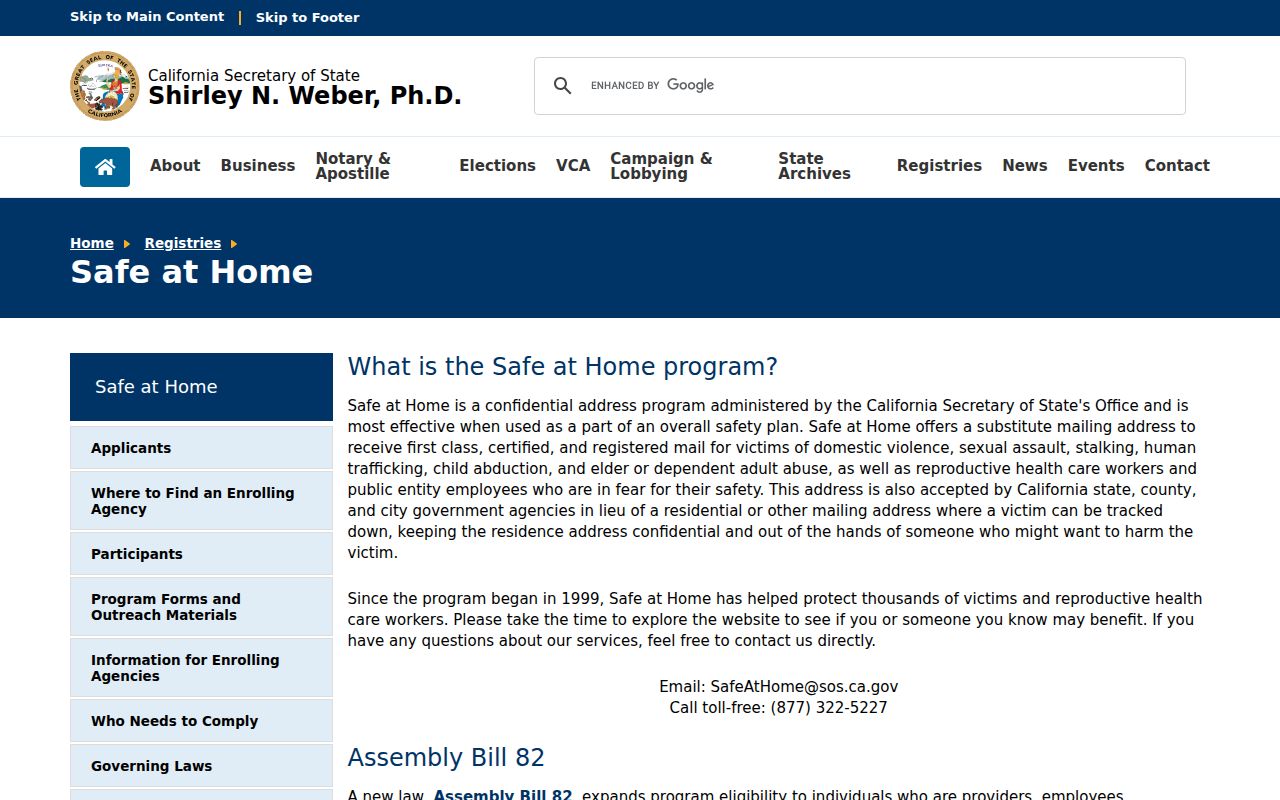
Safe at Home can provide a substitute mailing address and confidential voter registration for eligible Vallejo people, but it does not erase preexisting public records.
Lawful House History in Vallejo
Vallejo house history is a personal and family research use. Public availability does not permit stalking, harassment, trespass, impersonation, or exposure of a protected person. Keep current names and addresses to the minimum needed for the research question. Use the custodian for a correction and law enforcement for an immediate safety concern.
Lawful use. Vallejo previous residents records support documented house history, genealogy, and estate research. They do not authorize monitoring or confronting a person. Verify each record with its custodian and stop at a confidentiality rule.
For the present Vallejo parcel chain, the Vallejo street-by-address records page keeps current assessment, GIS, deed, and permit steps together. Previous residents should remain tied to their source year, while the Vallejo past trail shows exactly where current evidence ends and historical evidence begins.